
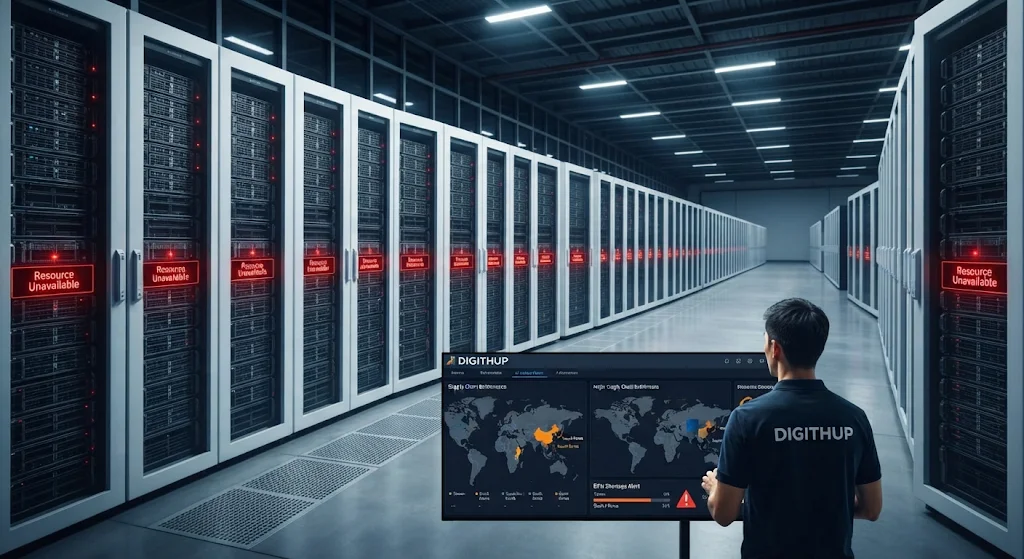
The Graphics Processing Unit (GPU) has evolved from a specialized graphics accelerator into the single most contested strategic asset in the global economy. As demand for AI training, inference-time reasoning, and high-performance computing surges, semiconductor leaders are pushing silicon physics to its absolute limits—while simultaneously triggering a structural global GPU supply shortage that is reshaping cloud pricing, hardware procurement, and enterprise software architecture.
To keep pace with trillion-parameter models and real-time multimodal workloads, modern GPU architectures have moved far beyond simple clock-speed increases. Today’s flagship accelerators rely on four foundational engineering innovations:
Chiplet Designs & Multi-Die Packaging: Rather than manufacturing massive monolithic silicon dies—which suffer from lower yields and thermal bottlenecks—modern GPUs interconnect multiple smaller chiplets via ultra-high-bandwidth bridges, delivering exponential gains in transistor density.
HBM3e and HBM4 High-Bandwidth Memory: Memory bandwidth, not raw compute, is the primary bottleneck in Large Language Model (LLM) inference. Stacked HBM3e and HBM4 memory modules sit directly beside the compute dies, achieving multi-terabyte-per-second throughput to eliminate data starvation.
Low-Precision Compute Engines (FP8 & FP4): Native hardware support for 8-bit and 4-bit floating-point operations (FP8/FP4 Tensor Cores) allows modern GPUs to double or quadruple AI throughput with negligible accuracy loss, dramatically improving performance per watt.
Direct-to-Chip Liquid Cooling: With single-GPU thermal design power (TDP) surpassing 1,000W to 1,400W, traditional air-cooled server racks can no longer dissipate heat effectively. High-density AI clusters now require closed-loop liquid cooling and rack-scale optical interconnects (NVLink/UALink) to operate as a single unified superchip.
Despite record capital expenditure from foundries and semiconductor designers, enterprise buyers and startups continue to face multi-month lead times and allocation caps. The bottleneck is no longer just the GPU silicon itself—it is a multi-layered supply chain constraint:
Advanced Packaging Bottlenecks (CoWoS): High-end AI GPUs depend on specialized 2.5D and 3D packaging technologies (such as TSMC’s CoWoS) to bond logic dies with HBM stacks. Packaging capacity remains heavily oversubscribed by hyperscalers.
HBM Memory Allocation Caps: Only a handful of memory manufacturers produce enterprise-grade HBM stacks, and annual production capacity is routinely sold out quarters in advance.
Hyperscaler Pre-Buying & Sovereign AI: Cloud giants and national Sovereign AI initiatives secure priority multi-billion-dollar allocations, leaving mid-sized enterprises, regional cloud providers, and independent developers competing for constrained secondary supply.
Power Grid & Data Center Readiness: Even when hardware is available, utility-scale power delivery and liquid-cooling retrofits delay cluster deployment by 12 to 24 months.
| Supply Chain & Tech Layer | Primary Engineering Innovation | Current Market Bottleneck | Direct Impact on Tech Companies |
| Compute Silicon | Multi-die chiplets & FP4/FP8 Tensor Cores | Leading-edge foundry wafer allocation | Higher upfront hardware cost per node |
| Memory Subsystem | Stacked HBM3e / HBM4 integration | Limited global HBM manufacturing capacity | Memory capacity dictates max model size |
| Packaging & Interconnect | 2.5D/3D CoWoS & rack-scale optical links | Severe advanced packaging backlogs | Extended 6–12 month hardware lead times |
| Data Center Infrastructure | Direct-to-chip liquid cooling (>1kW/GPU) | Electrical grid & cooling retrofits | Rising cloud GPU instance rental rates |
The global GPU crunch has triggered major structural shifts across international technology markets:
Cloud Compute Inflation & Spot Volatility: On-demand cloud GPU instances remain expensive and frequently unavailable in peak regions, forcing engineering teams to rethink naive "throw more compute at it" architectures.
Rise of Alternative Silicon & Custom ASICs: Hyperscalers and enterprise software teams are increasingly diversifying workloads across AMD Instinct accelerators, custom inference ASICs, and high-efficiency edge NPUs to reduce single-vendor dependency.
Shift Toward Software-Level Optimization: Because hardware cannot be scaled endlessly, competitive advantage has shifted back to software engineering excellence—specifically model quantization, speculative decoding, KV-cache compression, and routing queries to smaller domain-specific models.
At DIGITHUP, we view hardware scarcity as a catalyst for smarter software architecture. Rather than locking your business into bloated cloud bills or unattainable GPU clusters, our engineering teams build lean, resilient, and cost-optimized digital systems:
Compute-Aware AI Architecture: Designing hybrid inference pipelines that route routine tasks to lightweight, quantized Small Language Models (SLMs) while reserving heavy GPU compute strictly for complex reasoning.
Cloud Cost & Infrastructure Optimization: Architecting auto-scaling cloud backends, efficient caching layers, and containerized microservices that maximize throughput per dollar spent.
Custom Enterprise Platforms: Building high-performance web and mobile ecosystems engineered for speed, scalability, and seamless integration—whether deployed on public cloud, private VPC, or hybrid infrastructure.
Don’t let hardware bottlenecks or soaring cloud costs slow down your product roadmap. Partner with DIGITHUP to engineer high-performance, future-proof software built for maximum efficiency.
